Turning for Home

I’m currently in a suburb northeast of Columbus, OH, whose name I’ve already forgotten. I’ve crossed the Mississippi River at St. Louis, with the sun in my eyes (again…) and traveled what seemed to be a straight line through two and a half states. Five recharges in 451 miles.

Except for those puffy cumulus clouds over the mesas a few days ago, I have not seen another cloud during the whole trip. Completely clear, sunny skies. This pleasant sun has warmed the car such that I have not turned the heat on at all, thus extending my range. I am apparently traveling east with a huge high-pressure system containing very cold air – the temperature has never been above the mid-40s and averages at about freezing. It’s been as low as 10 on the road, usually before dawn. I started seeing snow on the ground about when I crossed the Mississippi – it went from no snow to complete cover.

From Oklahoma City, which really isn’t in the Southwest as such, I traveled northeast on I-44, which runs from OKC to St. Louis, and stayed just short of St. Louis last night. Most of the route is through the Ozarks, which is famous for its lakes, of which I did not see any. The landscape is very much like upstate New York – rolling, forested hills, which are not quite as high as those around Oneonta. This section of the trip – which I’ve taken three or four times now – is, frankly, boring. Not much to see and what there is to see is too familiar. You want it to end, but it doesn’t, and then you realize that when it does end, you have to drive through St. Louis.

Many other cities that get in your way when you’re driving cross-country have ringroads: interstate highways that circle the city and allow you to get through in a reasonably logical fashion. Columbus, for instance, which I just drove into the west of and exited out the northeast, with no trouble at all. St. Louis, however, does not have a logical (at least to me) system of highways, but instead has a bewildering system of a large number of highways, and if you miss the lane at the junction you could end up in Minnesota. I saw the Arch on the way through, and the Mississippi, on the way over, but just briefly, because I was very busy staying in the correct lane. So that’s how the day started.

Again, while talking with Abbey, it occurred to me that I’d seen essentially no farmland between California’s Central Valley, and the Mississippi. Obviously, there is farming done west of the river, but, apparently, not along I-40 or I-44. As soon as I crossed the river into Illinois, it was nothing but farmland.

By the way, speaking of renewable energy (previous post), while traversing the Texas panhandle, west of Amarillo, I drove through a windfarm that was twenty miles long. Enormous turbines as far as the eye could see. Then on the other side of Amarillo and into Oklahoma, a half dozen more, smaller but still out of proportion to anything we see in the east. Thousands of turbines in a couple hours driving, and that’s only what I saw. It was a wonderful sight.

And finally: today, in Indiana, I passed up the chance to get off the highway and see the World’s Largest Pitchfork. Sorry. Maybe next time.
Trip, as Opposed to Car

In talking with Abbey today, I realized that this blog is a way of communicating with two different groups of people with different reasons for keeping up with the trip. She asked why I had written so much about the car, and not as much about the trip itself. It never occurred to me to inform each group of the other.

The idea for this blog was born among the members of the Solid Waste and Environmental Concerns Committee (SWEC) of the Otsego County Board of Representatives, of which I am a member. When we’re not talking about solid waste, which we oversee, we’re often talking about renewable energy and how we can approach problems and opportunities in such a way as to reduce the County’s carbon footprint. As it turns out, there’s a lot we can do, and we try and do it. So when I mentioned that I was driving a Tesla across country, naturally the group was interested, and, long story short, I agreed to keep in touch through a blog. They’re the group interested in the car.

The other group of people who may or may not be reading this is my extended family, which means Abbey’s extended family, who apparently want to hear more about the trip and what I think of where I’ve been.

So I’ve unconsciously been writing in both directions, without explaining myself. So that’s why.

Southwest is More than an Airline

The Southwest (which I left last night, as I moved into Oklahoma) is very much like the pictures you’ve seen of it. It has a stark beauty that really appeals to me. The great, flat, brown and green sagebrush wasteland goes on forever, and the highway just travels through it, as if it were traversing an abandoned planet. When there are signs of habitation, they are very often old and abandoned, weathered and graffiti-ed, often fallen down, probably built before the highway and abandoned when the highway left them high and dry. Many of these are tourist-trap relics in the shape of teepees (even though the Southwest native Americans didn’t use teepees), often with huge arrows pointing into the ground.

There are, for sure, the mesas I mentioned previously, sometimes ranked in a range of mesas that are miles long. But mostly they are solitary, big and small, scattered randomly like strange statues from a forgotten world. There are what we think of as mountains, too, also scattered singly and randomly, sometimes in a range in the distance. Just outside Flagstaff, there is a huge, solitary mountain with snow on the top, which can be seen from thirty miles in either direction.

There are still attempts to sell to the travelers who are no longer traveling in the Southwest, but traveling through it. Occasionally a gift shop entrepreneur will put up huge billboard, six or eight at a time, evenly spaced over a half mile or so, each one shouting “Jewelry!” “Candy!” “Moccasins!””Clean Rest Rooms!” When you finally get to the shop, which is right at the exit (often the only thing at the exit) and clearly visible from the highway, it is clear that if you piled all the billboards up together they would tower over it. My favorite – actually, it was today, in Missouri, so not in the Southwest – is the Discover Uranus Sideshow Museum and Candy Shop. You just don’t see that sort of stuff in Massachusetts.

In Arizona, the highway rises to 7,300 feet above sea level (half again as high as Denver) at Flagstaff, in a scrub pine forest which, although the individual trees would feel at home on the Cape, leaves a very different impression: impenetrable and trackless. Then downhill almost all the way to Albuquerque, a bright, colorful city in a blasted, treeless valley twenty miles wide.

The colors in the rock strata can be breathtaking and the view is unparalleled. But it is also a place where many cultures flourished for centuries – millennia? – only to be remembered with a decaying plywood teepee and a forlorn attempt to make a 21st century life in an ancient land.

It’s Getting Easier

Well, sure, toward the Mississippi, but not over it yet. I really wanted to be in Illinois tonight, but Missouri is just too big. On the bright side, today was the first day of driving with no delays or obstructions – just driving and charging from before dawn to after sundown, a total of twelve and a half hours, six recharges, and only 522 miles.

By the way, that “before dawn” stuff: both today and yesterday, the sun rose on a long straight part of the highway, right in my lane. If that happens tomorrow, I’ll know it’s out to get me.

It really is getting easier. There’s a rhythm to it. Also, the chargers are closer together – maybe about 100 miles between them. I now spend the charging time going over the maps, figuring the distance to the next one, and charging only what I need. I double the distance (100 miles to the next one – 200 miles worth of charge) and add ten or fifteen miles of charge for good measure. That shortens the time for charging, and I get to the next one with plenty to spare (which also shortens the charging time). “Plenty to spare” is important, because that extra might be used if I have to do anything but drive directly from charger to charger.

I’ve finally (finally!) found a reliable way to use the onboard navigation system (I’ve always wanted to say “onboard”) to plot a trip right to the next supercharger. The problem – why that’s not simple – is complex, and I’ll go into it in detail if anyone’s interested, but I’ve spent a long time trying to trick the nav system into plotting long routes that have to stop at the next charger, so I can get to the next charger. I have also had to zoom way into the map to see what establishments are around the charger, and that has often been successful. But now I have found the secret handshake that will let the nav system take me right to it. Or close.

Sometimes the “plenty to spare” has to be used to find the charger in the first place. They’re almost always in parking lots, and mapping programs have a hard time with parking lots. Almost half of them have been in Holiday Inn parking lots, so that’s the first thing I look for. But some of them are hard. “Find the hidden Tesla charger!” This morning, in Oklahoma City, I wandered around for a while and finally went into a Whataburger whose parking lot the icon was in, and asked. The first employee asked another, who asked a third, a kid about 14, who knew all about it. The chargers were in a far corner of the adjacent shopping mall.

One of the interesting activities while charging is finding a place to go to the bathroom. When there’s a hotel near by, I go in and find the lobby rest room; tonight it was a BBQ joint in Missouri, and I asked the hostess, who had no problem with it. Earlier today it was a liquor store, which advertised discounts for Tesla owners.

I often have the bank of chargers to myself; sometimes there are one or two others. In Needles, CA, there is just one, at the corner of a combined Subway and Dairy Queen. Today there were three cars and the charger bank outside Tulsa, OK (the ugliest city in the country). The chargers were in the parking lot of the Hard Rock Cafe and Casino, which is ginormous, including a five-story behemoth where you park your car. I went in to find a bathroom, and walked almost all the way through before I found one. Dark, glitzy, cavernous – lots of chrome and carpet, and mirrors. Hundreds – hundreds! – of slot machines. Midmorning weekday, and there were people playing the slots. Just a different world – a different universe. They were playing good music, though (Ramones, Grateful Dead).

So range anxiety, I think, is a thing of the past, but I am still always thinking about range, because the options narrow so precipitously if anything involving off-route traveling occurs. Mostly, though, I just drive and enjoy the view.

Moving Along

Long day on Monday, from Gallup NM to Weatherford, OK. Five supercharger stops, not including Weatherford, which I’ll do this morning. I would have gotten farther but in Gallup, the first thing I did was go find a gas station that had air for tires at o-dark-thirty. Gallup is a city that is ten miles long and about a half mile wide, and I found air a long way from the hotel. I couldn’t find my wallet. Think, a minute, about what it would be like to be in Gallup, NM, without your wallet. No, don’t. It’s terrifying. After ransacking the car I drove all the way back to the hotel, searched my room, my breakfast seat, the parking lot. I was ready to walk off into the desert. Then I found it under the water bottle, just where I had put it. I’m an idiot.

Anyway, I got in too late last night to do any writing. More details soon Waiting for breakfast to be ready, and then off toward the Mississippi River.

More About The Car

It is ironic that Tesla has done more than any other electric vehicle (EV) manufacturer to increase range and reduce range anxiety – and yet range anxiety is the hallmark of my trip so far. I know, I know – the extra weight and the bikes on the back are not figured into the projections of how much power it will take to get to the next supercharger.

Abbey and I were talking on the phone about that today. Why don’t the power use predictions use the previous few days usage as a guide, instead of a one-size fits all? We agreed that the Tesla – and EVs in general – were aimed at a more urban and suburban market, commuters and residents of more densely-populated areas where car trips are much shorter. An EV won’t really be practical for a cross-country trip until the range is increased a little more, and so that kind of software upgrade will probably wait until then.

When charging, the display shows how many miles you can go on the charge that is currently in the battery. That number increases during the charging. As the battery gets full, it becomes harder to charge – each “mile” takes longer – until you’re waiting nearly a minute for each mile to be added. Apparently, most normal users set the charging system for 80%, which is usually enough. I usually take the time to get it to 90%.

I’ve discovered a faint, fine horizontal line on the “dashboard” display, between the speedometer and the number that indicates what your cruise control is set at. A little experimentation suggests that it tells me, in a general sense, how much power I’m using. A bold enhancement to the line extends to the right of center while driving; the further right, the more power is being used. The line can also extend to the left of center, but then it’s green – it tells me that, due to the driving conditions (using the brakes or the regenetive braking, for instance, or going down a hill), I’m adding power to the battery.

This, I think, was part of the problem last night, in the Mojave Desert, before I figured out the line – I mentioned the last twenty miles were downhill, but the previous sixty or seventy, it seemed, were uphill.

Some superchargers are hard to find, but all are exactly where the Tesla map says they are – except for one today which was on the other side of the road. After panicking a lot, I happened to glimpse the very distinctive charging stations across six lanes of traffic, behind a Burger King. The problem with finding them is that they are often in shopping centers, and the map can end before the end and you have to look around for a while.

A Nice Thing

This trip is turning out to be a little different than I though it would be, although I am learning, little by little, to make the adjustments needed to solve some of the problems.

The glorious parts of these trips is the scenery – seemingly unending beauty, and in great variety.

Today, about midday, on I-40 west of Flagstaff, AZ, I looked to my left (which would be north) and was transfixed. Not a startling or surprising sight – just a row of very eroded mesas, on the horizon about maybe 25-30 miles across a very flat scrubland. They weren’t very tall, but stood out in the flatness.

They were lit by the sun in such a way as to give them a pastel blue and pink glow. And they really did glow. But there’s more: there were small, puffy cumulus clouds above them, and they, also lit by the sun, also displayed a pastel glow. It was a fantasy landscape, out in the middle of nowhere, and I got to be part of it.

The nice thing about the West – I watched the show for nearly an hour, as I drove. The sun changed some, as did the clouds, but it stayed enchanting. That was a nice thing today.

Formatting

Just a quick note about formatting: I’m sorry. I cannot for the life of me figure out how to format anything in this version of WordPress, and I don’t really have hours and hours to learn. Believe me, if I had my way, it would look a lot better and be easier to read.

Oddly enough, the one formatting option that’s right front and center as one types is the drop cap. Go figure.

Interesting Development

Just a placeholder post here; got to get on the road. I think the character of the trip has changed some.

Turns out that the Tesla, with the extra weight (it’s really full) and the two bikes on the back (which affect its aerodynamic character) will not get near the number of miles on a charge that we expected.

It was a very close call last night between Mojave and Needles, perhaps the longest stretch without a supercharger on my trip. The car suggested that I drive more slowly to avoid running out in the middle of the Mojave Desert at night. I did about half the trip at 52 mph, and I turned the heat down to 60. Made it to Needles with about 30 miles to spare, but only because the last 20 miles or so was downhill. Got into the hotel room in Kingman just before 11:00 central time.

I hope to have time to write more tonight in Albuquerque or Amarillo (wow – there’s a country song for you), after stopping at every supercharger along the way.

First Charge-Up

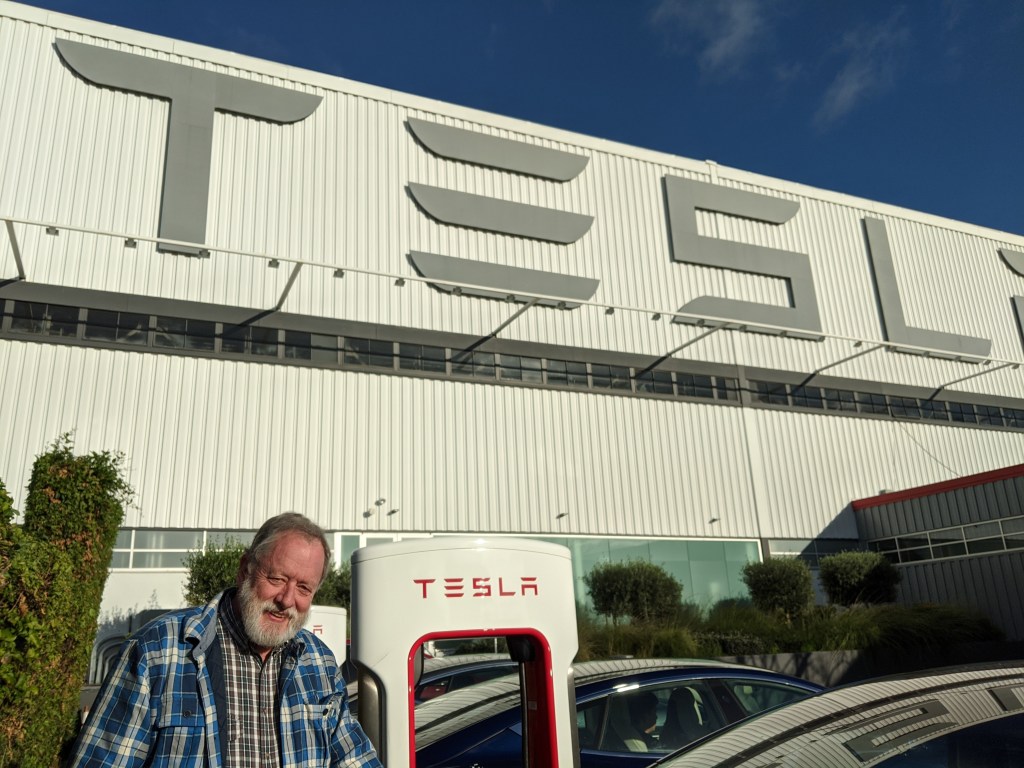
We charged up the Tesla today in preparation for departure tomorrow morning. The nearest charging station is… right outside the main entrance of the Tesla plant in Fremont, about a mile from Randall and Lily’s house.

We pulled in with very little charge and it took about twenty minutes to fill to 80%, which is the recommended level when you’re at a busy charging station (nice, sunny Saturday afternoon); it’s 90% when things are slow. It talks a looonng time to top off the last 10-20%. The charging stations – 24 of them – were all in use when we got there but two cars pulled out within two minutes.

The charging stations are wired in pairs, and if someone is charging on the other of the pair, both will experience slower speeds. Randall said that he often pulls in and sees a car at every other station.

Design a site like this with WordPress.com
Get started